
Thrust and Drag: How scarcity and structured demand shaped SpaceX’s record IPO
Authors: Ruben Pathmanathan, Marco Maglioli, Benedikt Loy, Kane Brown
With thanks to Michael Green (Tier1 Alpha) for his comments and assistance.
Introduction
SpaceX raised $86.25bn in June 2026, three times the previous record, selling just 4.86% of its shares. The $135 offer price implied an equity value of about $1.77tn, making SpaceX one of the ten largest listed companies in the United States on a float smaller than any mega-cap listing bar Saudi Aramco.
The scale of the capital raise was only half the story. SpaceX brought a limited supply of shares to market whilst attracting demand from retail investors, institutions and index-tracking funds. It also announced its intended offer price before completing the roadshow, giving investors an unusually clear valuation reference point from the outset.
This mattered more than it would have a decade ago. Index-tracking vehicles have grown substantially with passive assets overtaking active in the US for the first time in 2023 (Brightman, Harvey) and index funds now hold upwards of 30% of the float of the largest US-listed companies. For a listing of this size, index inclusion is therefore no longer an administrative step that follows price discovery — it determines a large proportion of demand for shares.
Three key features defined the IPO:
●A tight float: Just 4.86% of shares were publicly available, even after the underwriters exercised their option in full. The offer was entirely primary, with no concurrent sell-down by existing shareholders.
●Broad distribution: Retail investors received a reported allocation of c.20% of the base offer. This introduced a substantial source of demand outside the traditional institutional book-building process.
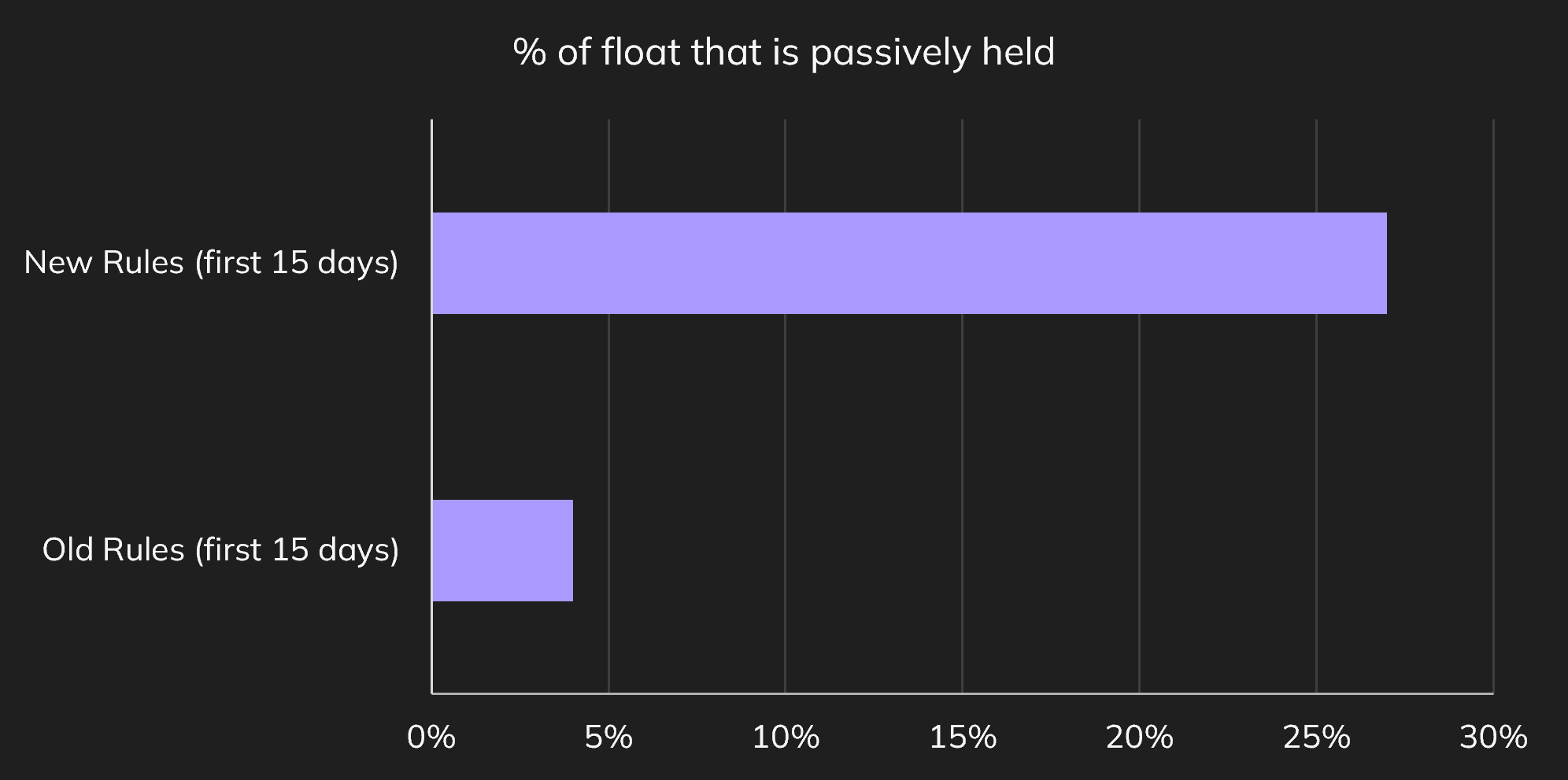
●Prospective index demand: Intropic modelled approximately 173m shares of index-linked buying during the first three weeks of trading. That was equivalent to about 27% of the initial public float.
Together, these factors concentrated demand into a relatively small pool of tradable shares. In our view, they strengthened the order book and created a supportive technical backdrop for early trading. They did not, however, guarantee lasting support for SpaceX’s valuation.
In this note, we examine how 1) Private-market valuation references 2) A low <5% float 3) Retail investor distribution 4) Accelerated index inclusion and 5) Lock-up releases have shaped early trading. With many similar large cap IPOs approaching (OpenAI and Anthropic), this serves as a useful blueprint for how they may approach their IPOs.
1. Private transactions anchored the $1.77trn valuation
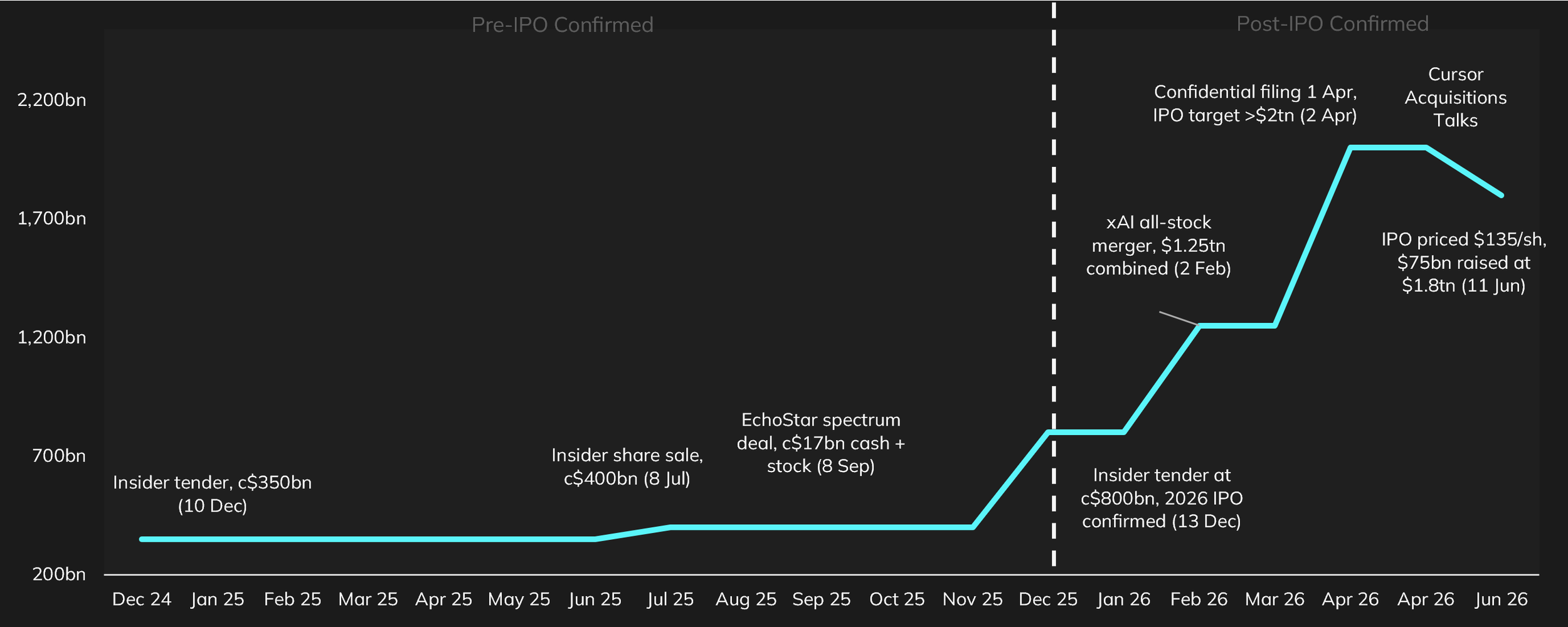
In the build-up to the IPO, SpaceX's valuation moved from c$350bn to $1.77tn in just eighteen months. Insider tenders took the valuation from c$350bn in December 2024 to c$800bn by December 2025, when the 2026 IPO was confirmed. Corporate combinations concluded the build-up. The EchoStar spectrum deal used SpaceX stock as consideration, the all-stock xAI merger lifted the base to $1.25tn in a single step, and the $60bn Cursor option was signed three weeks after the confidential filing. SpaceX announced an intended offer price of $135 per share on 3 June 2026, before formally pricing the IPO on 11 June and beginning trading on 12 June.
Private transactions repeatedly reset SpaceX’s valuation ahead of IPO
Source: Intropic, Reuters, Bloomberg News
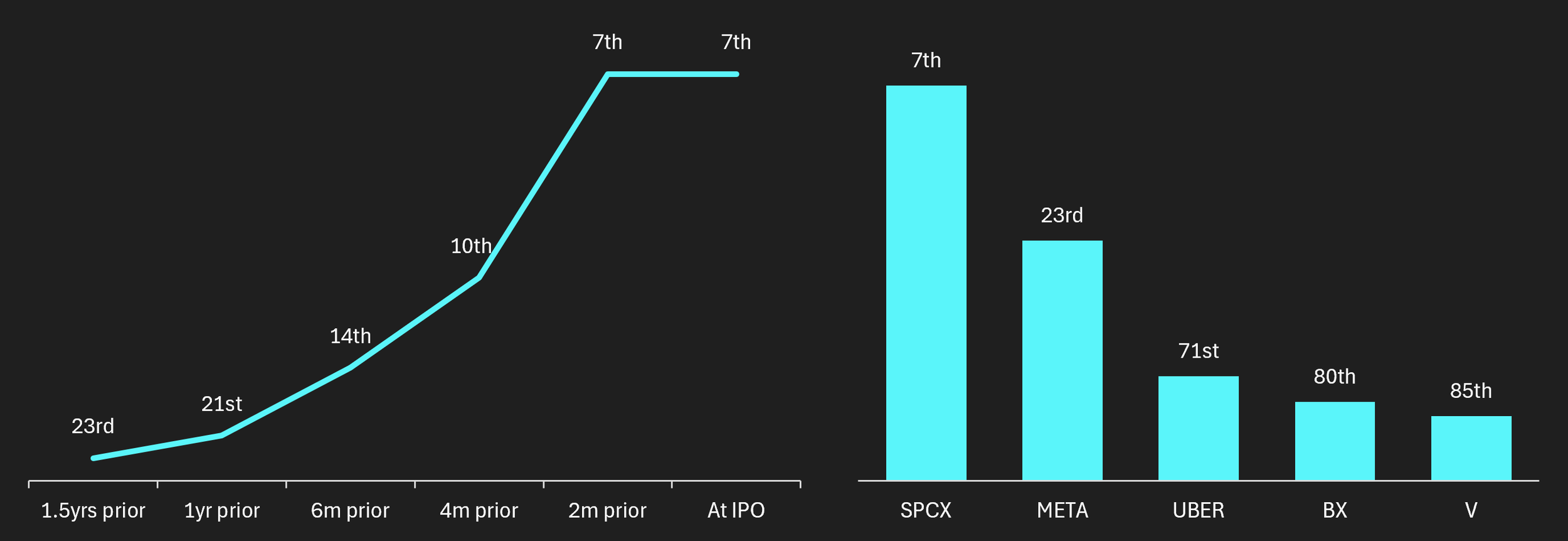
While tender offers at higher valuations are usual in late-stage companies, each combination established a new, higher reference point ahead of the IPO, with the private mark moving from $400bn to $800bn in the six months before the filing and the xAI merger adding a further $450bn in a single step. The Cursor option extended the same pattern into the offering window, committing the newly listed company to a further all-stock combination priced before public trading began. As a result, the eventual IPO valuation of c.$1.77tn represented a step up from the most recent private marks, ranking SpaceX among the top 10 US stocks by market capitalisation.
SpaceX entered the market as the seventh-largest US-listed company
Source: Intropic. Rank based on total market capitalization
Index eligibility was embedded in price discovery
The scale of the listing also tested the index industry’s established treatment of newly public companies. A prolonged exclusion risked leaving major US benchmarks without what was expected to be one of the country’s largest listed businesses, reducing their representativeness and creating an unusual exposure for index-tracking portfolios. Index providers faced the separate methodological question of how quickly a newly listed company of this scale should be represented in benchmarks designed to reflect the investable market. Their responses differed according to their respective index objectives, eligibility criteria and governance processes.
Against this backdrop, several providers reviewed their fast-entry arrangements, although their responses differed: some permitted accelerated inclusion for sufficiently large and liquid new listings, while others left their existing eligibility frameworks unchanged.
Given the importance of the changes, journalists published estimates of the index demand SpaceX would receive and the timeline over which it would arrive. Investors evaluating the offer therefore priced in near-term structural buying before the first trade printed, which stood to have a direct impact on the offer price on the first day of trading.
Modelled index-linked ownership reached 27% of the initial float
Source: Intropic
NB: as of 31/07/26. Lock up expiries in early August 2026 led to 6.9% of total shares becoming available to trade, significantly changing the profile of this chart.
2. SpaceX floated less than 5% of its shares
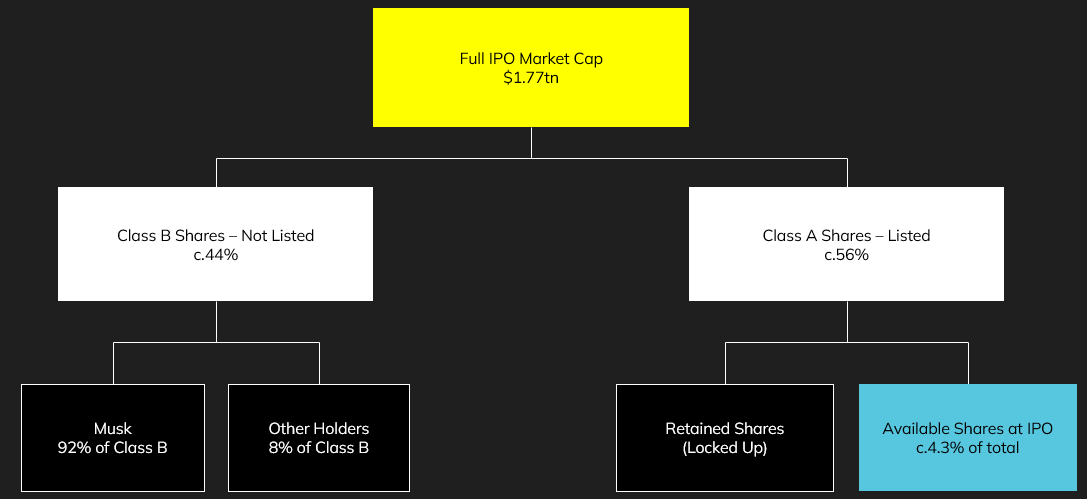
SpaceX entered public markets with a highly concentrated ownership structure. Even after the full exercise of the overallotment option, only 4.86% of its post-offering shares had been issued through the IPO, materially below the initial offer ratios of comparable large US technology listings. Public investors received Class A shares carrying one vote each, while Elon Musk retained significant voting power (82.3%) through ownership of c.92% of the supervoting Class B shares (42% of shares outstanding, each with 10 votes per share).
The investment community generally regarded SpaceX’s governance structure as favourable to management, although the dual class model itself was not unprecedented. Concern extended beyond voting rights. Institutional investors criticised SpaceX’s proposed mandatory arbitration provisions, restrictions on shareholder litigation and reliance on Texas corporate law, which collectively reduced the mechanisms available to challenge management. The Council of Institutional Investors, CalPERS and the New York state and city pension authorities publicly objected to the structure, while MSCI assigned SpaceX its lowest possible ESG rating CCC, citing weak governance and limited board independence (for context Tesla ranked “average” at BBB as of Apr 2025).
(1) SpaceX’s share structure at IPO (2) SpaceX IPO Float (%) vs selected large US technology IPOs
Source: Intropic, Prospectus Documents
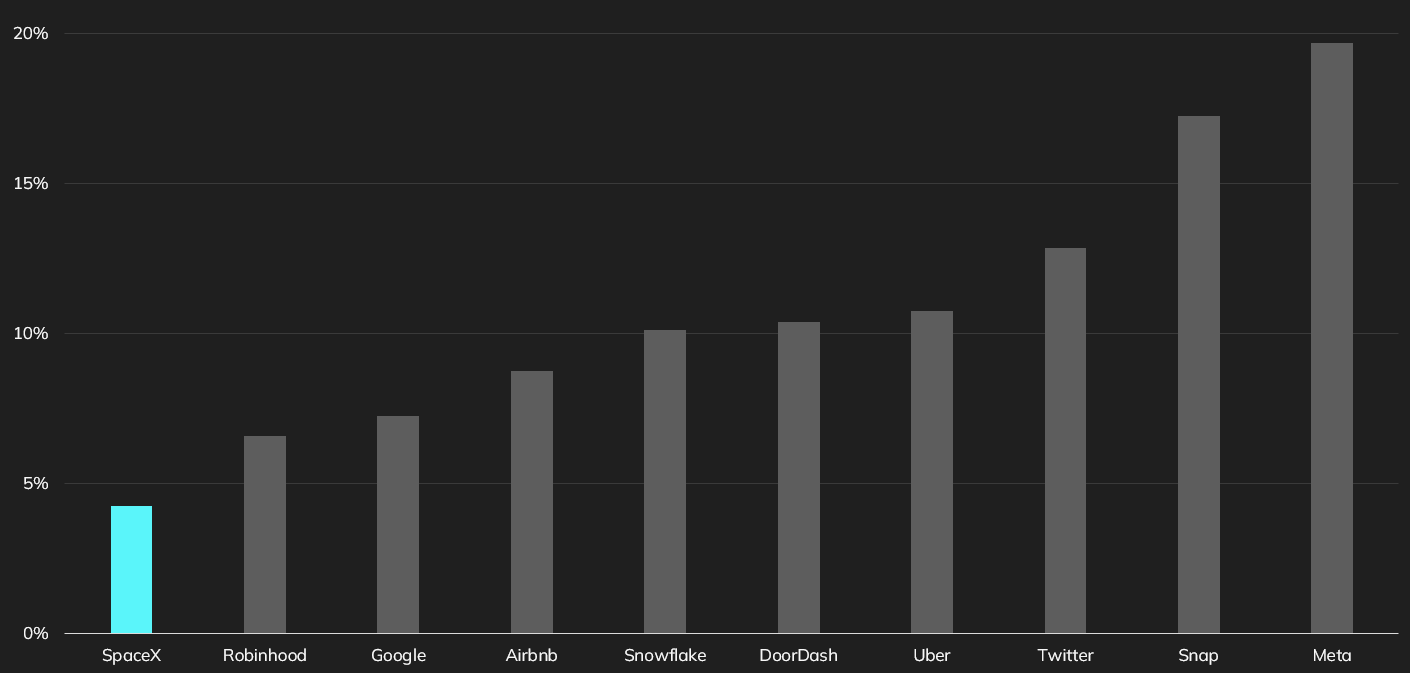
Source: Intropic. NB: Float (%) excludes excercise of greenshoe option
Scarcity strengthened the order book:
The restricted offer allowed SpaceX management to raise a record amount of capital with limited dilution, preserve founder control and retain most of the company’s future economic upside.
Restricting the float concentrated retail, institutional and index demand into a small pool of shares, supporting the offer valuation — and, in early trading, the price. The IPO was reportedly c.3x oversubscribed, with retail investors c.6x reportedly oversubscribed for their eventual allocation (Financial Times).
These benefits seemingly came at the expense of weaker price discovery, increased volatility and a persistent supply overhang from future lock-up expiries. The structure secured demand at the point of pricing and left the question of value to be resolved in a secondary market with very limited free float. In our view, the expectation of index-related passive demand, fuelled by press coverage of potential index methodology changes and the resulting prospect of fast entry, influenced the secondary market's assessment of valuation.
That influence can be sized. The three index-related trades cleared at average prices of $184.98, $153 and $160.42, each materially above the $135 offer price. Across the roughly 173m shares traded across those three events, the spread over the $135 offer price amounts to approximately $5.5 billion in aggregate offer-price benchmark spread.
3. Retail investors absorbed 20% of the offer
The average retail allocation of floated shares falls between 5-7% for US IPOs (WSJ), with SpaceX’s pre-emptive allocation range flagged to fall between 20-30% (this was eventually confirmed at 20%). Whilst some other large cap tech IPOs have also shared high retail allocations (Robinhood at 20-25%, and Meta at 25%), SpaceX’s reported allocation to retail on an absolute dollar basis was significant ($15bn vs Meta at c.$4bn and Robinhood at $418m).
To place this sizable tranche, SpaceX took a very proactive approach to signing up retail investors.
A deliberately broad distribution:
Rather than treating retail as a small residual allocation, SpaceX incorporated individual investors directly into the primary distribution process. The strategy had three distinguishing features:
Primary-market access on institutional terms: Retail investors could submit orders before listing and purchase allocated shares at the same $135 offer price as institutional investors. This allowed individuals to participate in the bookbuilding process rather than waiting to buy in the aftermarket.
Distribution through mass-market US brokers: SpaceX made the offer available through Charles Schwab, Fidelity, Robinhood, SoFi and Morgan Stanley’s E*Trade. Fidelity temporarily lowered its eligibility requirement from $100,000 to $2,000 in brokerage assets, while Robinhood and SoFi imposed no minimum portfolio balance. This materially widened access beyond the traditional institutional and high-net-worth IPO client base.
A multi-jurisdiction offering: SpaceX established local offering routes in Australia and Japan, alongside retail offerings in seven EEA countries and Switzerland. The UK’s Public Offer Platform provided an additional route into the global book without requiring SpaceX shares to be listed in London. The result was an international primary distribution programme rather than a US IPO followed by overseas aftermarket participation.
According to the Financial Times, UK demand exceeded 100,000 investors and almost $1bn of requested shares. Approximately $364m (2.7m shares) was ultimately allocated. Applications of up to $2,700 were filled in full, while larger orders were scaled back. Alongside the lower eligibility thresholds offered by some brokers, this suggests a deliberate preference for a broad base of smaller shareholders.
Retail holders initially proved relatively sticky:
Comprehensive US retail data is not yet available, but early evidence from Hargreaves Lansdown suggests that UK participation was not dominated by immediate flipping.
Only 8% of participating clients sold on the first trading day, despite the shares rising from $135 to $161. Four weeks later, 80% still held their shares, even after the price had fallen by approximately one-third from its $225 peak. Funding came principally from new deposits and existing cash rather than the sale of other investments.
The investor base was also unusually new to equities:
● For c.20% of participants, SpaceX was their first direct equity investment.
● For c.40% it was their first investment in a US-listed company.
These figures indicate that most UK participants had not sold during the first four weeks. That is not necessarily evidence of high-conviction, long-term ownership: the data covers only UK platforms and a short period after listing. It does, however, suggest a less speculative initial shareholder base than the scale of retail participation might imply.
Why retail participation mattered:
Historical research (Aggarwal) provides some support for the idea that retail allocations can reduce immediate selling pressure. Among the strongest-performing IPOs in 1997-98, institutional investors sold approximately 47% of their allocations during the first two days, compared with 28% for retail investors. Several brokers participating in the SpaceX offer also imposed 15- or 30-day anti-flipping restrictions, ensuring longer term holding.
Retail investors therefore represented a material source of demand and price formation, not merely a supplementary distribution channel. Their approximately $15bn allocation was reportedly more than six times oversubscribed, with retail orders alone sufficient to cover the entire IPO offer. The strategy broadened the order book and may have limited immediate post-IPO selling. We would not read it as evidence of permanent support for SpaceX’s valuation.
4. Index demand concentrated buying into three events
Much of the debate ahead of the IPO centred on the changes many index providers made to their fast-entry frameworks, which had the effect of enabling SpaceX’s early inclusion. The changes principally involved relaxing free-float thresholds and shortening seasoning requirements, and in some cases introducing float-sensitive weighting caps (notably, Nasdaq capped low-float weighting at 3×), and they divided opinion across the market.
Some felt that SpaceX’s immediate representation in indices was vital, as the indices by construction are supposed to represent the top market cap components of a market, while others objected, arguing that fast-entry changes made shortly before a major listing raised questions about index-provider independence, curtailed price discovery and left passive investors buying a newly listed, low-float stock at what they considered inflated prices.
There is a coherent case for early inclusion: a benchmark that omits one of the ten largest companies in its market no longer describes that market, and funds tracking it inherit a tracking error they did not choose. Whatever the reasoning, though, the effect was a large, well-telegraphed and price-insensitive source of demand arriving into a float of under 5%, on a timetable every participant could estimate before pricing.
In a Jan-2026 paper, Chris Murray and Marco Sammon examine IPOs added to CRSP’s Fast Track indices five trading days after listing. They estimated that Fast Track IPOs outperformed comparable non-Fast-Track IPOs by 5.16 percentage points from the first-day close to index inclusion, with significant reversal beginning the following day and continuing for up to three weeks. The authors estimated CRSP-tracking funds’ demand at roughly 7% of total shares issued; anticipated inclusion was also associated with IPOs raising 6.2% more capital than expected from the initial prospectus terms.
If the c.27% SpaceX index-fund demand is measured consistently as the proportion of shares issued in the offering, it is materially larger than the c.7% demand shock studied by Murray and Sammon. That comparison suggests a potentially greater effect on secondary-market trading and IPO price-setting. However, the study does not establish a linear relationship between index-fund demand and returns, and the actual effect will depend on timing, liquidity, overlap among indices and how much demand was anticipated. The pre-rebalance moves in our charts below are therefore descriptive evidence rather than a causal estimates.
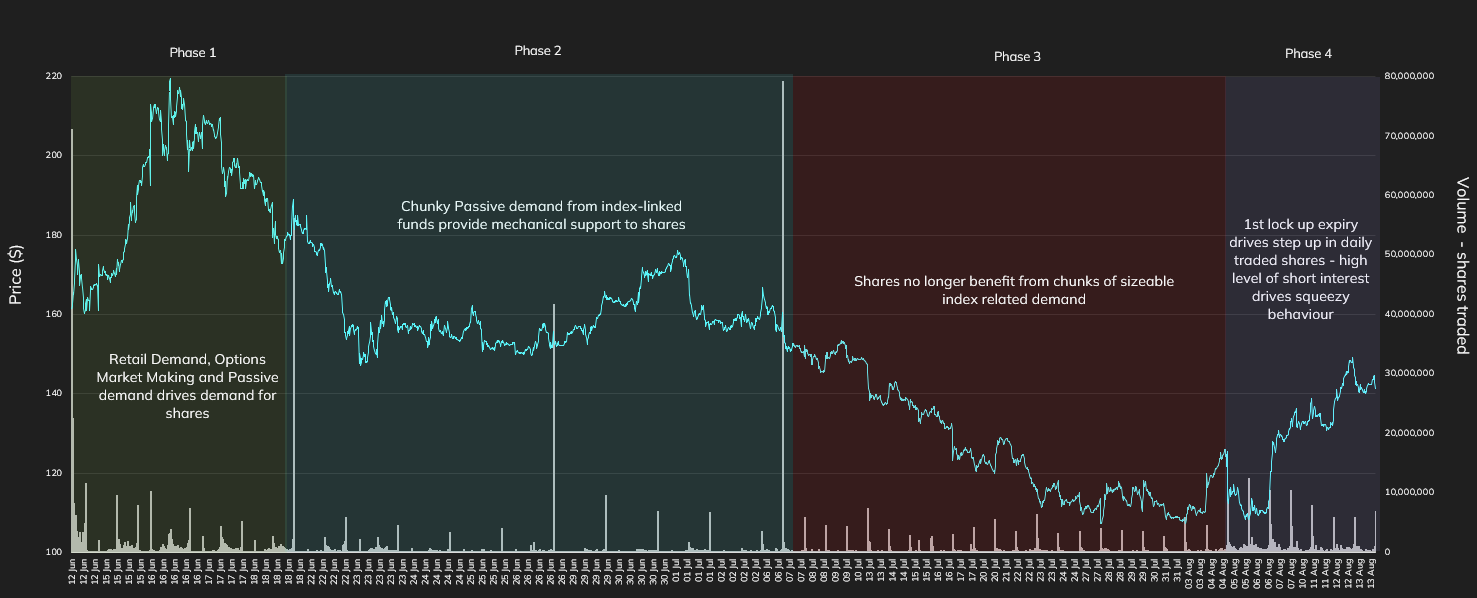
SpaceX’s IPO over 4 key phases: structural bid was concentrated in early trading
Source: Intropic, Bloomberg
Focusing on the first phase (green part of the chart) retail demand, options market making, and investors moving ahead of the expected dates of passive demand from indices all likely contributed to the price upside.
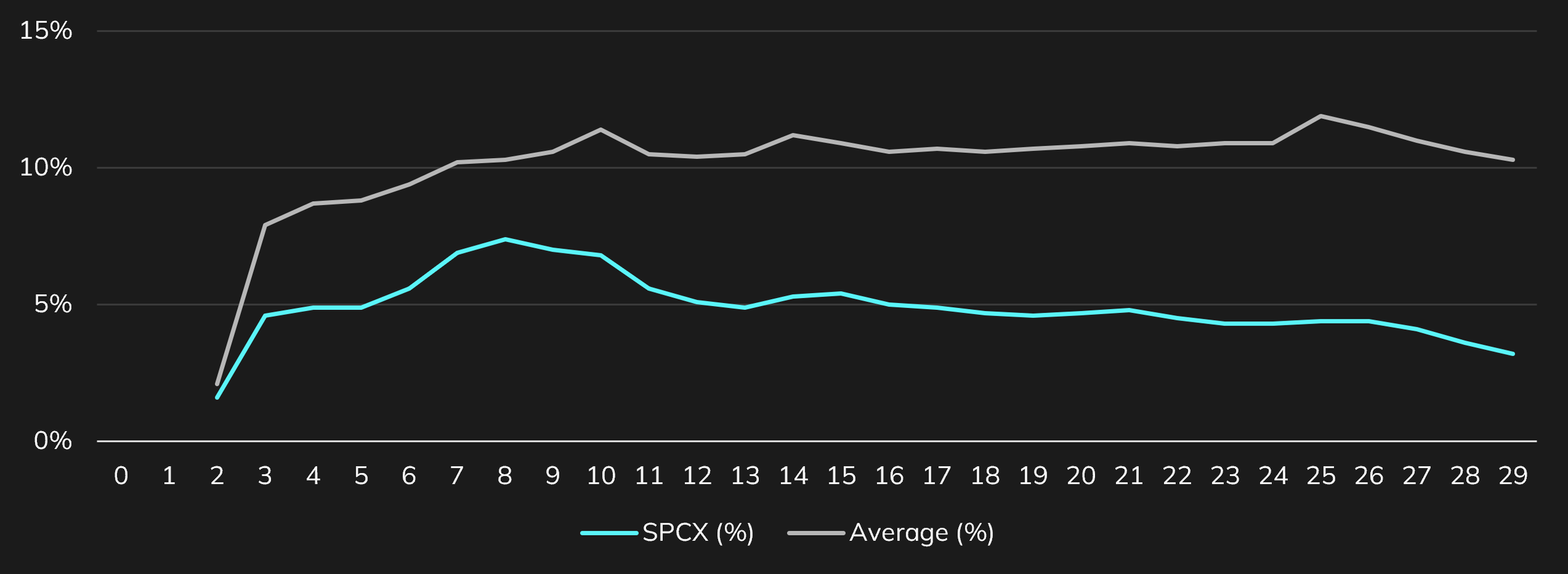
This share price spike was further amplified by securities lending dynamics. With insiders locked, and 27% of a tight float forecasted to migrate into index vehicles, borrow availability was scarce. As a result, pressure on the short side may have been constrained, due to the relatively low availability of shares to loan, potentially amplifying the share price pop seen across the first 5 days of trading in the shorter term. This was reflected by the Indicative availability data (of shortable shares), which continued to remain low relative to other recent IPOs over the first few weeks of trading.
Indicative availability (%) of shortable shares remained below the recent-IPO peer average
Source: Intropic, S3 partners
NB: Average takes the first 29 trading days of 18 recent US large cap IPOs: (SKHY, VG, RIVN, CPNG, CBRS, ARM, ABNB, NU, MDLN, PATH, SNOW, HOOD, APP, CRWV, INIO, TOST, FIG, LINE)
Phase 2 was a period of relative stability - prices still moved, but the lower bound was c.$145. Over this period, SpaceX was added to various indices, in a total of three passive demand events. These events provided structural support for shares, with the anticipation of sharp periods of inelastic buying demand acting as an overhang on trading activity. Once the index rebalance events completed, there was no longer the sudden structural support of these passive flows. Whilst the passive bid didn’t completely end once this phase was complete (with SpaceX still standing to benefit from ongoing “passive” flows via the continuous bid from investors via 401k contributions, further lock-up related index upweights etc.), the sheer scale of individual passive buying days had passed.
The more precise description of this effect is not that passive flows put a floor under the shares, but that they narrowed the base of shares available to set the price. Index vehicles do not assess valuation on entry, and they do not sell on valuation either. With approximately 27% of a 4.86% float held in index vehicles, price formation for a company valued at c.$1.77tn rested on roughly 3.5% of shares outstanding. The drift and falling volumes described in phase three are consistent with that narrower base rather than at odds with it.
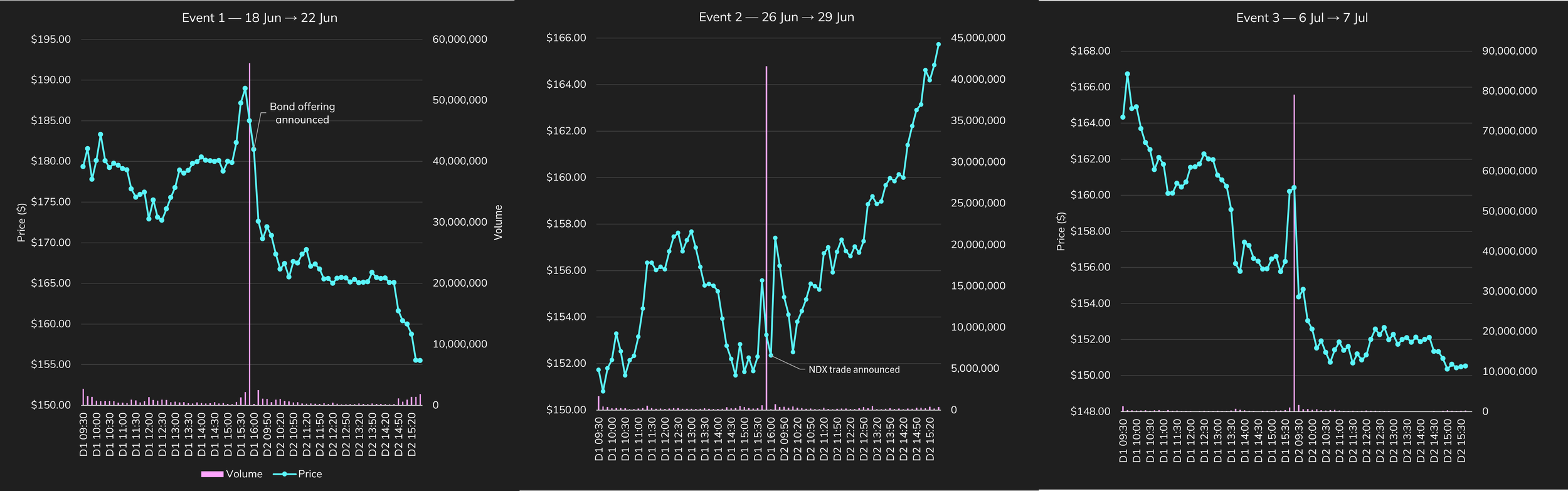
Looking more closely at the individual days of index-linked demand, the first index rebalance (1) occurred at the close of 18 June, whereby index tracking funds were mandated to purchase c.60m SpaceX shares. Prices rose by c.5% just ahead of the inclusion event, with the rebalance trade settling at $184.98. Prices fell on the trading day immediately after, with the bond announcement, options expiry, and 1st leg of passive support passing seemingly the catalysts for this decline.
Prices held at this level until the next passive demand event - whereby SpaceX shares were added to 2 indices, resulting in demand for c.44m of shares. Once again, prices rose just ahead of this event, with the trade settling at $153. The upcoming NDX trade was announced after market close, which appeared to spur on shares ahead of this trade.
The final passive event over the period was SpaceX’s addition to the NDX on 6 July. This was the largest of the 3 events (c.69m). Shares once again ran up just ahead of the event, with the index rebalance trade priced at $160.42. Shares underperformed after this event, with the stock readjusting to reflect lower levels of “structural” demand.
A closer look at trading on the days in which SpaceX was added to various indices
Source: Intropic, Bloomberg
NB: these charts are intended to flag the implications of index additions on traded volume. Gross exchange volume traded on the spikes are not solely attributed to net index demand
The pattern supports two conclusions
1) The post-rebalance declines are consistent with crowded pre-positioning. In each case, the share price strengthened shortly before the index-related trade before reversing once the anticipated demand had been completed. This suggests that at least part of the expected passive buying had already been reflected in the price and that investors used the rebalance liquidity to unwind positions. The index rebalance community would likely have had limited spare capacity to fund events of this size on its own, particularly while carrying other comparably sized rebalance trades over the same period.
This suggests that part of the demand was met by other market participants, some of whom appear to have used the rebalance liquidity to exit positions while minimising price impact.
2) The anticipation of large days of structural index-related demand had a material impact on the IPO pricing (both ahead of pricing and in early days of trading). This is backed up by both the Murray and Sammon study referenced above, but also through the individual index trade-days evidencing pre-positioning.
The third phase of the IPO didn’t benefit from the significant waves of passive linked buying activity that the 2nd phase benefitted from. As a result of this, both volumes traded and share prices trended lower. This behaviour flipped into the fourth phase, with the first lockup expiry, which we provide more detail on in the next section.
5. SpaceX’s unique lock-up expiry
Source: Intropic forecasts as of 24/08/26
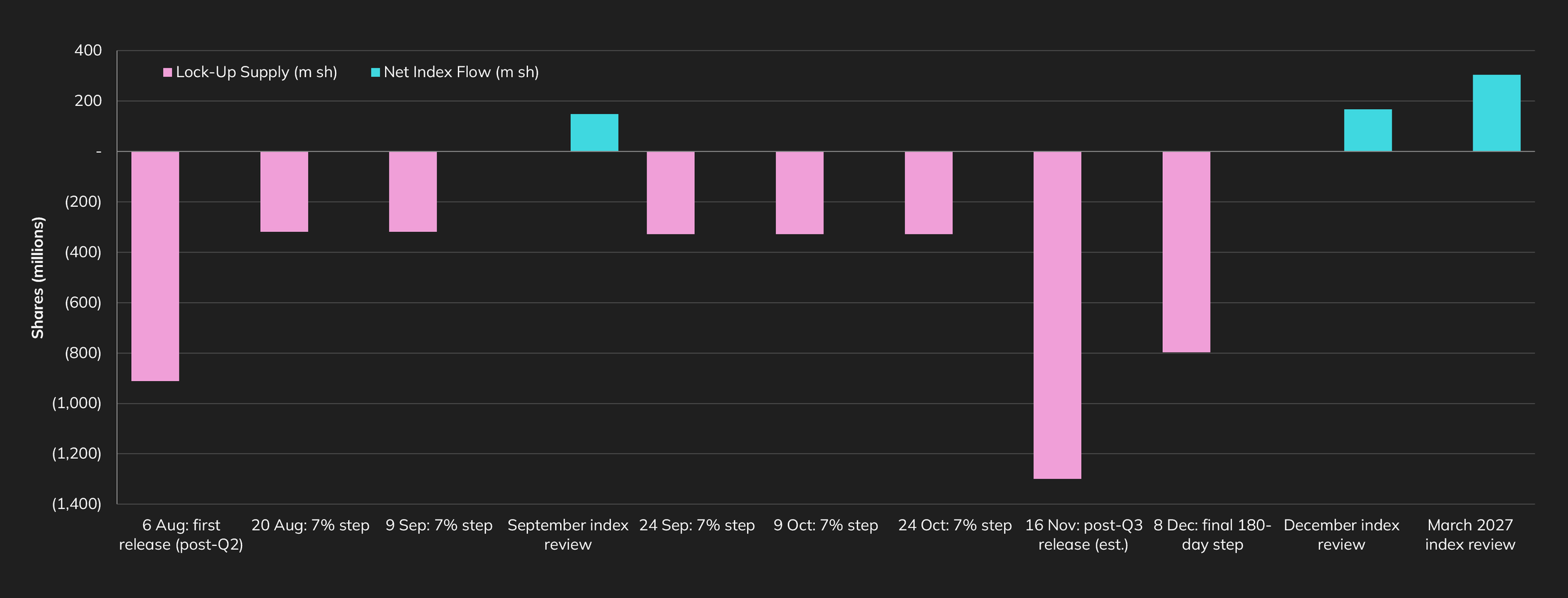
Most US lock-ups are a single 180-day cliff: nobody sells for six months, then everybody can. SpaceX built something far more granular — three separate agreements, more than a dozen release dates, the last of them in mid-2027. Since no existing shareholder sold into the IPO, these are the first opportunities any pre-IPO holder has had to reduce. As at 24 August 2026, two have passed.
Shares unlock through three overlapping mechanisms: fixed calendar dates, earnings reports and a conditional price trigger. The initial price trigger lapsed unmet at the first earnings date. It required five closes at or above $175.50 — 130% of the offer price — in the preceding ten trading days; the highest close in that window was $125.33, and the shares have not closed above $175.50 since 18 June. The 455.8m shares in that tranche were not cancelled, but roll forward into the final step, which will now release 797.6m shares on 8 December rather than 328.4m.
The different cohorts within the lockup expiry:
The 180-day cohort — employees, former employees and holders who are not Rule 144 insiders — releases in eight steps, of which two have occurred: 20% on 6 August and 7% on 20 August. Four further steps of 7% each fall between early September and late October, 28% follows two trading days after Q3 results, and the remainder releases on 8 December.
The extended cohort keeps 75% of its holdings locked across six dates in 2027, while the remaining 25% follows the same 180-day schedule as everyone else. Confirmed signatories include Valor (503.4m shares, 6.2% of Class A), Google (551.2m, 6.8%) and the Founders Fund (427.3m, 5.3%) — 18.3% of Class A between them.
Elon Musk is locked for 366 days with no early release of any kind. His holding will not free until 12 June 2027, tradable from 14 June.
That 25% carve-out matters more than its size suggests, because it means every pre-IPO holder other than Musk has stock releasing on the near-term schedule. It does not change the size of any individual release, but it widens the set of holders able to sell into one. A separate restriction still binds: Rule 144 bars affiliates from selling until 10 September, when 45.7m shares become sellable by insiders for the first time.
The first releases were absorbed comfortably - index demand may have a role:
The first release, following Q2 results, freed 911.5m shares on 6 August — approximately $99bn, or 11.4 times average daily volume. Contractually unlocked supply rose from 4.8% to 11.8% of shares outstanding, more than doubling the tradable base in a single step.
The market took it without difficulty. The shares rose 6.1% that day on roughly three times recent turnover, and a further 15.8% in the following session to close at $133.11, though still below the $135 offer price. A second tranche of 319.0m shares followed on 20 August, and a third of the same size is due in early September.
Lock-up expiries can create passive demand for companies already included in indices, because an increase in investable float can require some index funds to buy additional shares. The important counterfactual for SpaceX is that, under the previous fast-entry rules, its thin initial float would not have qualified for inclusion. Its early lock-up releases would therefore have occurred while it remained outside the indices and would have been pure supply events. The rule changes instead allowed SpaceX to enter before the releases began, meaning the additional supply can be met by some automatic passive demand.
The sellers into that demand are pre-IPO holders whose most recent valuation reference points were set in insider tenders and all-stock transactions rather than in open-market trading. The buying that meets them is executed at prevailing prices regardless of valuation.
The demand follows on a different timetable:
The supply schedule and the index schedule do not move in step. Implementation timing varies, and the demand arising from these releases will be spread across three review cycles rather than arriving alongside the unlocks themselves. On central-case assumptions we expect index-related demand of approximately $19–20bn in September 2026 and approximately $22bn in December, the December figure being net of some offsetting supply.
The largest tranche is not expected until March 2027, at roughly $40bn — about twice the size of the September programme, and nine months after the first shares were released. In aggregate, the three review cycles to March 2027 carry index-related demand in excess of $80bn.
The counterfactual is what makes SpaceX’s lockup expiry interesting – under the previous rules, SpaceX would not have qualified for inclusion on a float below 5%, and every release between August and December would have been supply unmet by a mandated buyer. Instead, these releases are expected to be met by index demand of >$80bn.
Conclusion: Tying these forces together
Source: Intropic
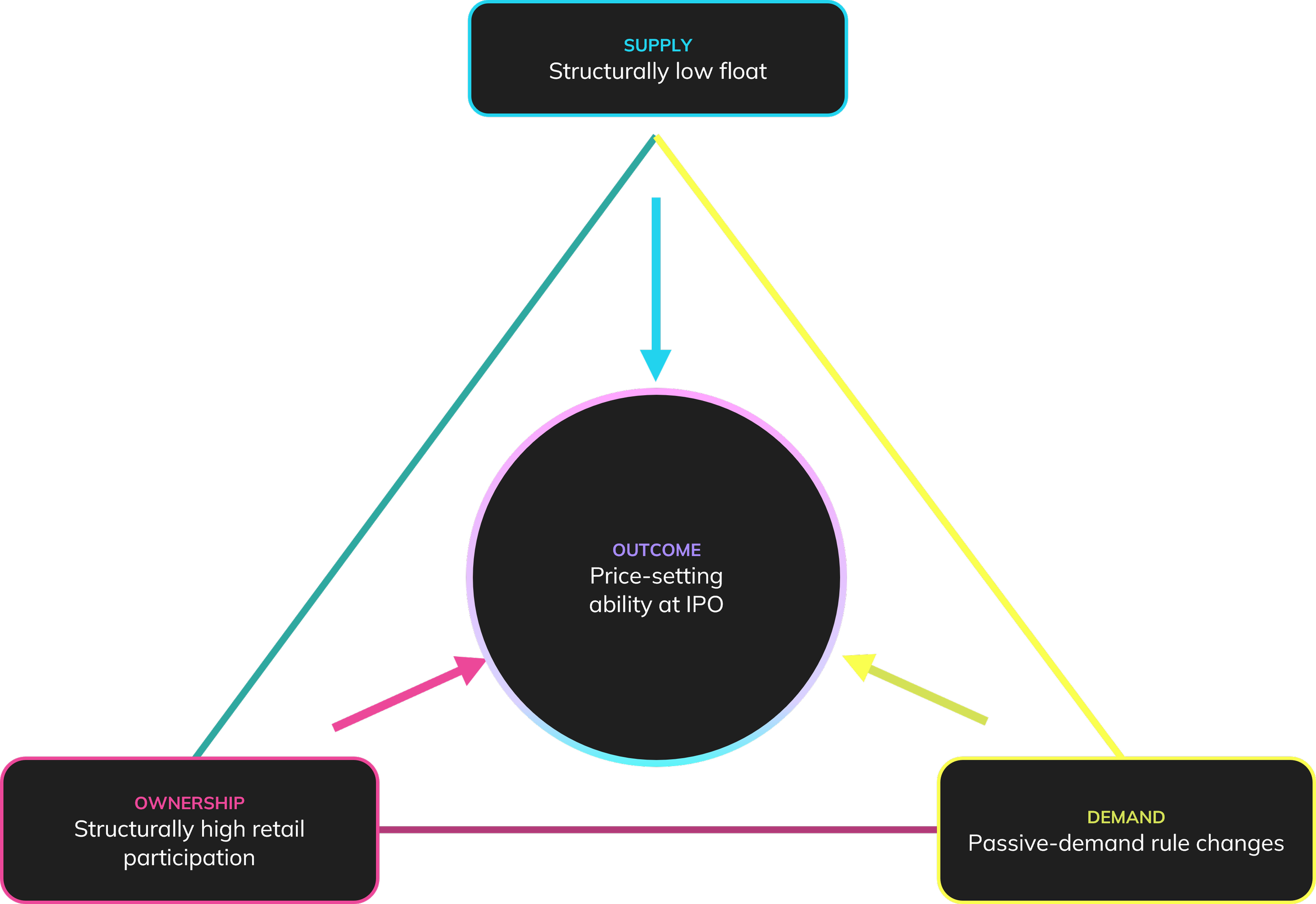
In summary, we believe SpaceX’s key innovation was not simply raising a record amount of capital but shaping the composition and timing of demand. By combining a small float, broad retail distribution, an early valuation anchor and visible index-entry pathways, SpaceX reduced its dependence on the traditional institutional book and gained greater influence over the conditions in which the IPO cleared. This was not unilateral pricing power, but it altered the balance between issuer and investors.
That makes SpaceX a potential blueprint for future mega-cap, low-float IPOs. Issuers may seek to replicate its use of retail access and anticipated index demand to maximise primary proceeds while limiting dilution. The trade-off is that such structures front-load demand and concentrate price discovery within a narrow pool of shares, increasing the risk of volatility and a supply overhang once index buying ends and lock-ups expire.
For investors, the lesson is clear: in the next generation of mega-IPOs, the architecture of the float, and structural flows, could matter more than the underlying fundamentals.
-
Purpose. This note has been prepared by Intropic and is provided for information and discussion purposes only. It does not constitute investment advice or a recommendation, nor an offer or solicitation to buy or sell any security, and it takes no account of the objectives, financial situation or needs of any recipient.
Sources and estimates. The note draws on public filings, prospectus disclosure, exchange and index-provider publications, press reports and Intropic's own modelling. Figures attributed to Intropic — including estimated passive demand, tracking assumptions and float adjustments — are produced by our own methodology and may differ materially from actual flows. Third-party figures are reproduced as published and have not been independently verified. No representation or warranty, express or implied, is given as to the accuracy or completeness of the information contained herein.
Opinion and third-party statements. Statements in this note concerning the conduct, decisions or intentions of any company, index provider, regulator or other third party are commentary and opinion formed on the basis of publicly available information. Where the note reports arguments, criticisms or concerns raised by market participants, those views are attributed to the parties expressing them and are not findings or conclusions of Intropic. Nothing in this note is intended to suggest that any index provider acted otherwise than in accordance with its published methodology and governance processes, or that any party acted improperly.
Forward-looking statements. Expected demand, unlock effects and implementation timings are forward-looking and depend on index-provider decisions, market conditions and fund behaviour outside our control. Actual outcomes may differ materially. Past performance and historical index-related flows are not indicative of future results.
Index and trademark references. Index, benchmark and company names are used for identification and analytical purposes only. Their use does not imply any endorsement, sponsorship, affiliation or commercial relationship between Intropic and the relevant provider or issuer.
Interests. Intropic and its affiliates, directors and employees may hold positions in, transact in, or provide products and services relating to the securities and indices referenced in this note.
Reliance and distribution. Recipients should not rely on this note as the sole basis for any decision and should obtain independent advice where appropriate. This note is intended for professional and institutional recipients and may not be reproduced or redistributed, in whole or in part, without Intropic's consent.
-
This report draws on company filings and announcements, academic research, financial-press reporting, Bloomberg market data and Intropic analysis. Links were accessed in August 2026.
SpaceX filings and company announcements
SpaceX final IPO prospectus, June 2026.
SpaceX announcement of the pricing of its initial public offering, June 2026.
SpaceX announcement of the IPO closing and full exercise of the underwriters’ option, June 2026.
EchoStar announcement of its spectrum sale and commercial agreement with SpaceX, 2025.
Private-market valuation and corporate transactions
Financial Times reporting on the SpaceX share sale that valued the company at approximately $350bn, December 2024.
Reuters reporting on the SpaceX insider share sale at an approximately $800bn valuation, December 2025.
Financial Times reporting on SpaceX’s acquisition of xAI, 2026.
Reuters reporting on SpaceX’s acquisition of Anysphere, the operator of Cursor, 2026.
Ownership and governance
SpaceX final IPO prospectus—principal shareholders, share classes, voting rights and lock-up arrangements, June 2026.
Council of Institutional Investors letter concerning the SpaceX IPO, June 2026.
Retail participation
Financial Times reporting on the UK retail offer, June 2026.
Result of the SpaceX UK retail offer, London Stock Exchange announcement, June 2026.
Barron’s reporting on retail access to the SpaceX IPO through Fidelity and other brokers, June 2026.
Financial Times reporting on the subsequent behaviour of UK retail holders, 2026.
Lock-up arrangements and subsequent trading
SpaceX final IPO prospectus—shares eligible for future sale and lock-up release schedules, June 2026.
Academic research
Brightman, Chris, and Campbell R. Harvey, “Passive Aggressive: The Risks of Passive Investing Dominance”, July 8, 2025. Also available through the SSRN DOI.
Aggarwal, Reena, Nagpurnanand R. Prabhala and Manju Puri, “Institutional Allocation in Initial Public Offerings: Empirical Evidence”, Journal of Financial Economics, Vol. 68, Issue 1, 2003, pp. 111–135.
Murray, Chris, and Marco Sammon, “Primary Capital Market Transactions and Index Funds”, The Review of Asset Pricing Studies, Vol. 16, Issue 2, June 2026, pp. 163–202.
